MTA Lendület Research Group · Budapest · since September 2026
One sky, four messengers
Pinpointing cosmic particle accelerators in the multimessenger sky
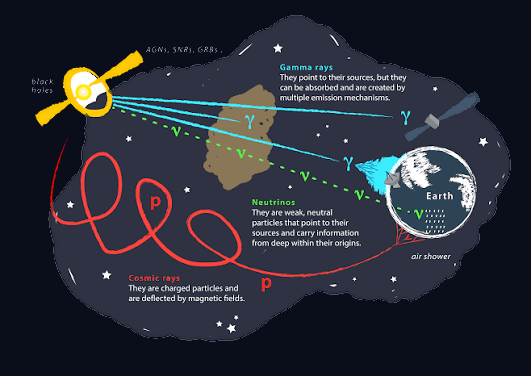
NuLab combines high-energy neutrinos, electromagnetic radiation and ultra-high-energy cosmic rays to understand the most energetic engines in the Universe, with connections to the gravitational-wave sky. Our central question is where, and under what physical conditions, active galactic nuclei become efficient factories of high-energy neutrinos.
What we work on
High-energy Neutrinos
The origin of IceCube's cosmic neutrinos
Where are high-energy astrophysical neutrinos predominantly produced? In relativistic jets, or closer to the black hole in compact, photon-rich environments such as the X-ray corona? We combine IceCube, Fermi-LAT, hard X-ray, and radio observations to test these scenarios across different populations of candidate active galactic nuclei (AGN).
Hard X-rays and Neutrinos
The hard X-ray–neutrino connection in AGN
We found observational evidence that the intrinsic hard X-ray luminosity of AGN scales with their neutrino luminosity across both radio-quiet Seyferts and jet-dominated blazars. If confirmed at the population level, this relation could turn hard X-rays into a predictive tracer of hidden hadronic activity and point to compact environments near the black hole as important neutrino-production sites.
Gamma Rays and Radio
Locating the neutrino factories in AGN
Once a candidate neutrino source is identified, we ask where within the AGN the emission originates. Gamma-ray light curves and spectra, radio monitoring, and VLBI jet kinematics reveal whether high-energy activity is linked to the central engine or to disturbances farther downstream in the jet. Multiwavelength time delays then translate variability into physical distances and propagation scales.
Gravitational Waves and Periodicity
Supermassive black hole binaries
Inspiralling supermassive black hole binaries can leave dynamical fingerprints on AGN jets, including precession and quasi-periodic variability. We search for these signatures by combining long-term gamma-ray variability with VLBI binary candidates and testing IceCube data for phase-dependent neutrino emission, connecting high-energy particle acceleration to the gravitational-wave sky.
News
-
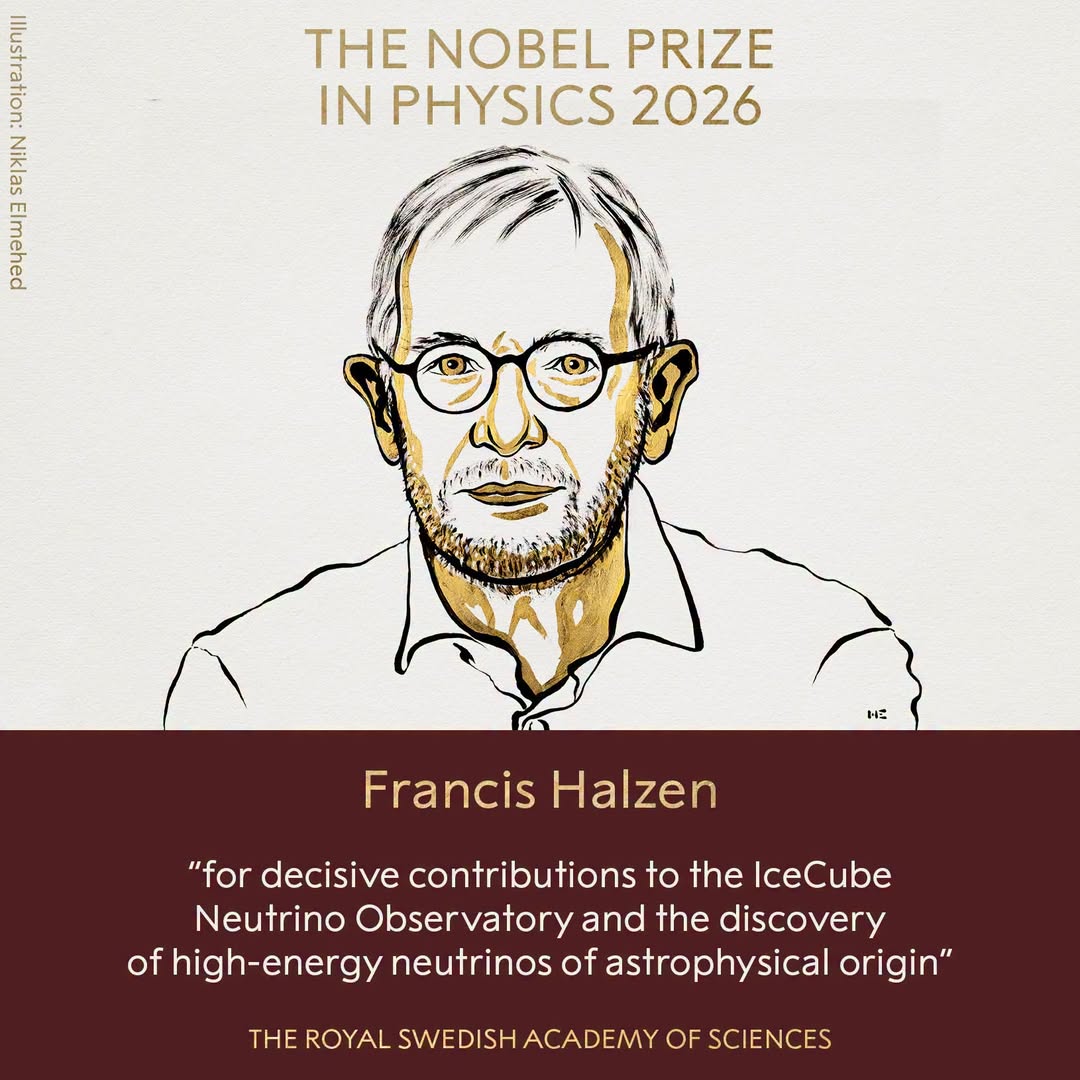
We warmly congratulate Prof. Francis Halzen of the University of Wisconsin–Madison, Principal Investigator of the IceCube Collaboration and our long-time collaborator, on receiving the 2026 Nobel Prize in Physics!
-
Máté Krezinger joins NuLab as a postdoctoral researcher in VLBI radio astronomy. Welcome to the team, Máté!
-
NuLab launches at Konkoly Observatory, funded by the MTA Lendület (Momentum) programme.
-
We are hiring a postdoctoral researcher in multimessenger astrophysics. Details and how to apply →